Building & Retrofitting for Health: Future Proofing Social Housing Across the Full Scope of Awaab’s Law
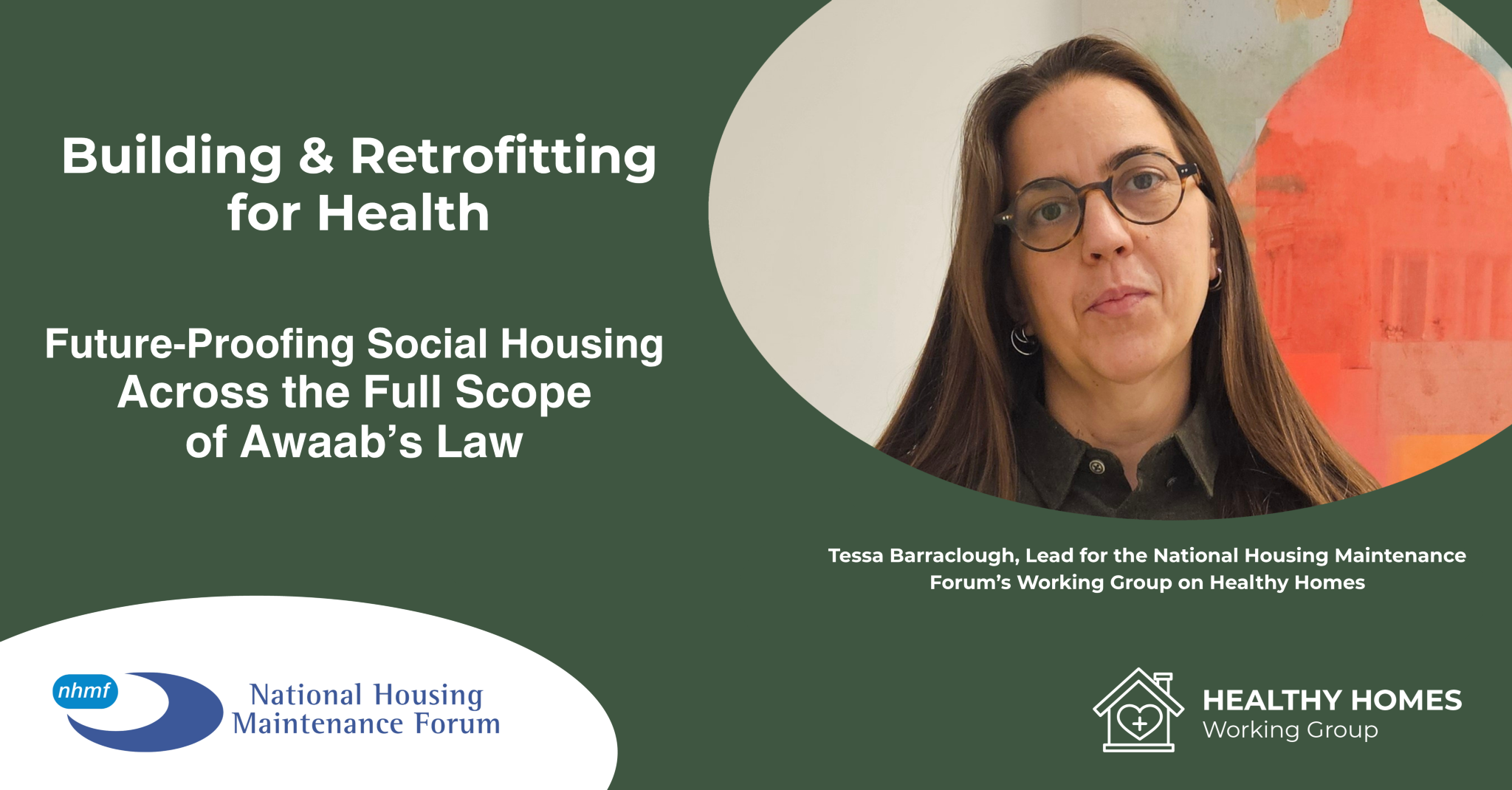
Tessa Barraclough, Lead for the National Housing Maintenance Forum (NHMF)’s Working Group on Healthy Homes, and Riverside’s Assistant Director for Asset Strategy and Sustainability, explores how the UK social housing sector must prepare for Phase 2 of Awaab’s Law without undermining the progress made under Phase 1.


With Phase 1 of Awaab’s Law now firmly in force, it is tempting to treat compliance as a discrete, time‑limited task: fix the damp, log the case, meet the deadline. But that mindset is dangerously narrow and risks leaving the sector underprepared for what follows.
Phase 2 comes into force in October 2026, bringing excess cold and excess heat, falls, structural collapse, fire, electrical hazards, and hygiene hazards into statutory scope. Phase 3 follows in 2027, completing the full set of HHSRS hazards. Every social home occupied today, and every social home delivered tomorrow, will need to perform across that full spectrum under legally enforceable timeframes.
The fundamental question is whether the homes we are repairing, retrofitting and building now are capable of meeting that standard – or whether we are storing up the next generation of compliance failures.
The Retrofit Paradox
The energy efficiency agenda and the Awaab’s Law compliance agenda are running in parallel across the sector. That alignment is welcome. The connection between poor energy performance and damp is well established: research confirms that around 20% of social renters in the least energy‑efficient homes experience damp problems, compared with around 3% in the most efficient. Improving our stock’s energy performance is not a distraction from Awaab’s Law. It is fundamental to meeting it sustainably.
However, a paradox sits at the heart of retrofit. While retrofit strategies reduce energy consumption in social housing, evidence shows they can also increase overheating risk if poorly designed. Professor Rajat Gupta of Oxford Brookes University, drawing on the HEARTH and INHABIT research programmes, highlighted the scale of the problem at the most recent NHMF Conference: 83% of London homes currently overheat, and by 2030, 9 in 10 UK homes are predicted to do so. This represents a serious public health issue, not simply a comfort concern.
Increasing airtightness through insulation, better windows and draught‑proofing reduces heat loss in winter. Without adequate ventilation and solar control, it can also trap heat in summer, raising internal temperatures to levels that present real health risks, particularly for elderly residents, young children and those with cardiovascular or respiratory conditions. These are precisely the tenant groups whose vulnerability Awaab’s Law requires us to factor into risk assessments.
Poorly executed retrofit can also trap airborne pollutants. Everyday activities such as cooking, drying laundry and cleaning release compounds that, in a well‑ventilated home, disperse safely. In airtight homes without sufficient ventilation, they accumulate, compromising indoor air quality and worsening respiratory illness.
A building cannot be “too airtight”, but it can be under‑ventilated. If that balance is not addressed, we risk complying our way from one HHSRS hazard straight into another.
PAS 2035: The Framework We Must Use Consistently
The PAS 2035 retrofit specification, updated in 2023, provides a robust and legally defensible framework for getting this right. Its core principle is “build tight, ventilate right”: every measure that increases airtightness must be accompanied by ventilation capable of maintaining healthy indoor air quality. Ventilation is not optional; it is the difference between resolving one hazard and creating others.
PAS 2035 also demands a “whole house” approach. No single measure should be considered in isolation. Adding loft insulation without reviewing kitchen and bathroom ventilation is not retrofit; it simply transfers risk between hazard categories.
To comply, a retrofit team including coordinator, assessor, designer, installers and evaluator is required. Where skills cannot be built in‑house, TrustMark‑registered professionals must be used. Where mould or condensation is persistent, enhanced solutions such as mechanical extract ventilation or MVHR should be specified.
From October 2026, excess heat becomes a statutory hazard. Landlords who pursued piecemeal retrofit without proper ventilation or solar management now face direct legal exposure. The window to address that risk is closing.
New Build Cannot Be Exempt from This Thinking
There is a widespread assumption that new build social housing is isolated from the Awaab’s Law challenge. New homes meet modern Building Regulations - surely they are compliant by design? The evidence suggests otherwise.
Since December 2021, Part O of the Building Regulations has required new homes to limit overheating risk. CIBSE TM59 sets the benchmark: bedroom operative temperatures should not exceed 26°C for more than 1% of annual hours. Monitoring studies show that more than two‑thirds of flats in one Passivhaus social housing scheme exceeded summer limits, while a wider UK study found 55% of bedrooms failed TM59 criteria, even in mild summers. Overheating risk was highest for vulnerable occupants – exactly the groups Awaab’s Law prioritises.
Building regulations are explicit that overheating must be addressed at design stage, not retrofitted. That principle aligns directly with Awaab’s Law. A new social home that overheats in summer is a home generating statutory excess heat complaints from day one.
The Future Homes Standard, published in March 2026 and taking effect from March 2027, strengthens this framework with low‑carbon heating, improved airtightness, enhanced ventilation and stricter overheating controls. If applied properly, it should deliver homes that are warm, well‑ventilated and resistant to summer heat.
With the move from SAP to the Home Energy Model to assess UK homes energy performance the government has emphasised closing the gap between theoretical design performance and real‑world outcomes. A home that passes calculations but underperforms in use can still overheat, trap pollutants and generate statutory complaints. Design decisions on orientation, glazing, shading and cross‑ventilation have lifelong HHSRS consequences. Treating them as value‑engineering targets is building tomorrow’s disrepair caseload.
The Updated HHSRS Operating Guidance
In March 2026, government published the first major revision to the HHSRS Operating Guidance since 2004. This framework underpins every hazard investigation, enforcement decision and legal challenge.
Hazards have been consolidated from 29 to 21, while scoring has shifted from an A–J scale to a simpler High, Medium and Low banding, with Category 1 & 2 thresholds unchanged. The aim is clearer, more defensible decision‑making in a system where challenges are routine.
A key operational change is the introduction of baseline indicators – non‑exhaustive checklists supporting preliminary assessments by non‑specialist staff. They do not replace professional judgement, but they enable consistent triage at scale.
The guidance reinforces whole‑dwelling assessment, including shared spaces, the primacy of professional judgement, continuing professional development, and robust record‑keeping. While HHSRS assesses risk to the most vulnerable age group, Awaab’s Law imposes a legal duty to act for the residents actually living in the home.
What This Means for the Sector Now
The NHMF Healthy Homes Working Group is clear that providers must:
- Treat ventilation as non‑negotiable in retrofit
- Commission post‑retrofit monitoring, including summer temperatures
- Embed overheating risk into stock condition surveys
- Require TM59 modelling at design stage for new build
- Invest in resident engagement
- Secure specialist supply chains before Phase 2
- Train teams on the updated HHSRS guidance
A Coherent Vision of the Healthy Home
Awaab’s Law is defining what a genuinely healthy home looks like: not just free from damp and mould, but warm in winter, tolerably cool in summer, well‑ventilated year‑round and responsive to occupant vulnerability.
That is not merely compliance. The homes we retrofit and build today are the homes we will be legally accountable for tomorrow. We need to make sure they are genuinely up to that challenge.
If you would like to be part of the NHMF Healthy Homes working group, contact me directly: tessa.barraclough@riverside.org.uk.