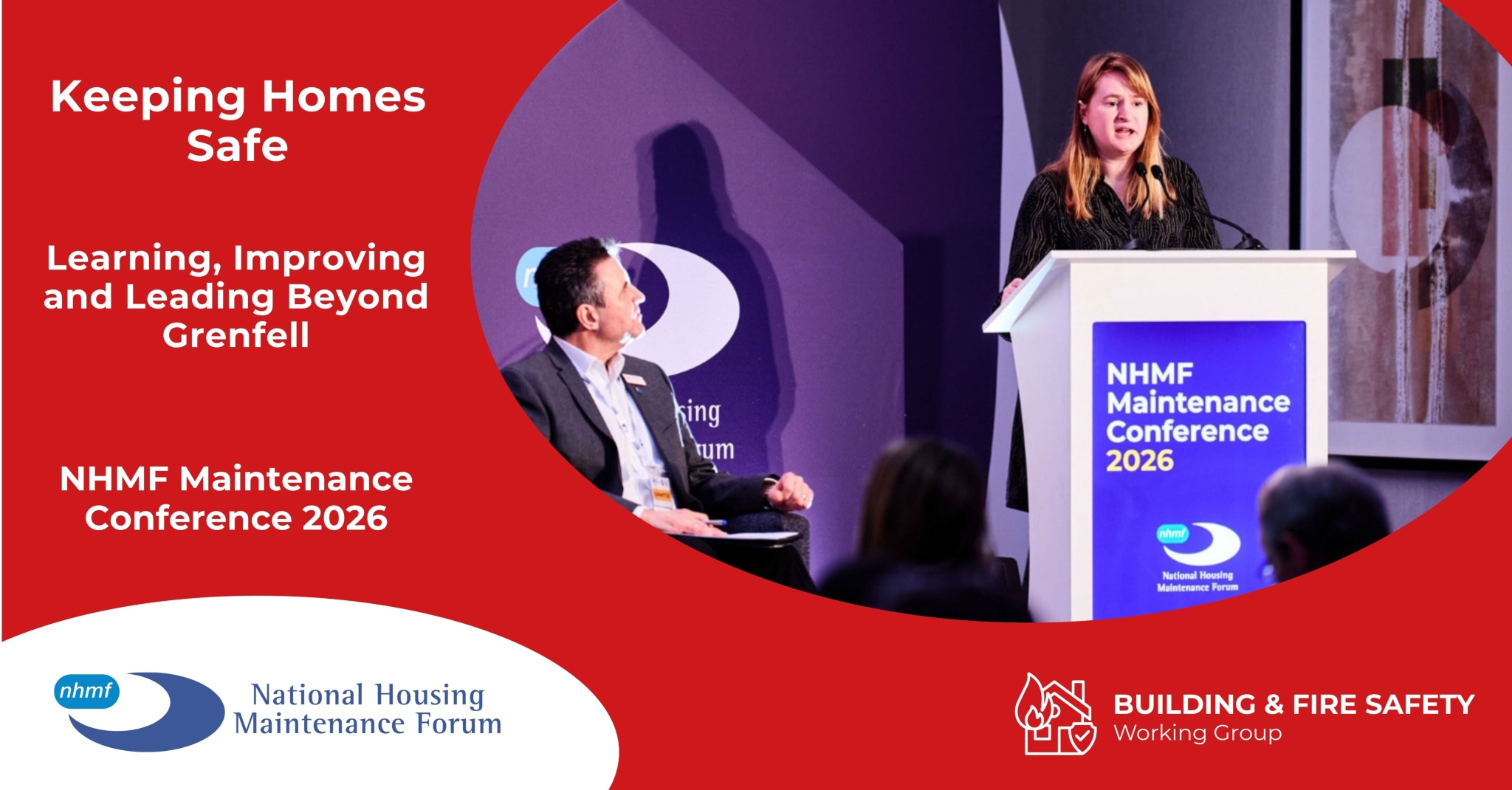
NHMF Plenary 2 : Keeping Homes Safe - Learning, Improving and Leading Beyond Grenfell
When Kate Lamble volunteered to cover the Grenfell Tower Inquiry for the BBC in 2018, she uncovered something far more troubling than the immediate causes of one catastrophic fire.


Her acclaimed 10-episode series "Grenfell: Building a Disaster" revealed fundamental failures in how the country approached safety & regulation in high rise buildings.
Julian Ransom, a Director at iON Consultants and NHMF Working Group lead for Net Zero, recognised the power of Kate’s storytelling to illuminate the systemic failures behind the tragedy and persuaded her to bring those lessons to a social housing audience at the 2026 NHMF Conference.
We were privileged to have Kate join us with speakers James Gibson the Health and Safety Lead at RLB and Kelly Rossington from Orbit Group to dissect these lessons with uncomfortable precision, offering a preview of the transformation the sector must undergo.
The Devil in the Details
The story of Ed Daffarn, who lived on the 16th floor of Grenfell, demonstrates how tiny decisions cascade into tragedy. On the night of the fire, just 20 minutes after flames broke out on the fourth floor, the blaze had climbed the building's combustible cladding to reach the 16th floor. The new occupant of a previously empty flat fled, leaving the door open. There should have been an automatic door closer. There wasn't.
Maintenance had removed the broken mechanism weeks earlier without replacing it. The missing door closer allowed thick black smoke to fill the communal hallway. Ed Daffarn became lost in that smoke whilst attempting escape. Firefighters searching for his neighbour, 69-year-old Joseph Daniels, rescued Ed, while Joseph Daniels died in his flat.
Every flat front door should have had an automatic door closer fitted. A previous proposal for regular checking and maintenance of these devices had been rejected by the local council. Maintenance staff appear not to have been informed about their importance. One small component, one administrative decision, one life lost.
The Attention Deficit
The inquiry found that Grenfell was the culmination of decades of failure by central government to carefully examine the dangers of combustible materials on high-rise buildings and act on available information.
From 1991 onwards, materials meeting government safety standards were involved in fires. Subsequent fires in the UK and abroad generated recommendations from coroners’ reports and select committees for guidance changes and reviews. Nothing changed. In 2016, during Grenfell's cladding installation, industry conference attendees raised concerns and sent emails directly to civil servants responsible for guidance. Still nothing changed.
Government departments are driven by short-term priorities: manifesto promises, vote-winning ideas. Safety becomes background noise requiring constant watching rather than action. Between 2010 and 2016, government priorities centred on "slashing red tape" and "health and safety gone mad" rhetoric. The inquiry found this deregulatory agenda meant that even matters affecting life safety were ignored, delayed, or disregarded.
At local level, Kensington and Chelsea Council had no key performance indicators for fire safety. Without rigorous scrutiny, fire safety management was weak. There was no complete fire safety strategy and no adequate system ensuring defects were correctly remedied. Where organisations place their attention matters fundamentally.
The Culture of Dishonesty
The inquiry concluded that manufacturers of cladding and insulation engaged in deliberate and sustained strategies to manipulate testing processes, misrepresent test data, and mislead the market.
In the early 2000s, regulations changed to allow combustible insulation on high-rise buildings if used as part of material systems passing large-scale fire tests. This created clear commercial opportunities. Passing these tests became targets for junior staff.
The manufacturers of the FR5000 cladding first large-scale fire test failed. Their second test used thicker cladding panels and magnesium oxide, a material so non-combustible it lines furnaces. Magnesium oxide use was not mentioned in test reports or marketing materials. A junior technical team member testified: "My understanding was that a decision had been made by senior management. I didn't know who I should speak to or who I could speak to. I lacked, I guess, the life experience to find a way forward."
The manufacturers of Kooltherm K15 that was used as a small portion of the insulation behind the rainscreen conducted one successful large-scale fire test. Despite the fact that only that exact tested system would have been suitable for high-rise buildings, and despite their insulation's chemical composition having since changed, they continued advertising their product as suitable. According to the enquiry when a customer requested evidence of suitability for a wide range of facades, the technical manager forwarded the email to a friend saying the customer was "getting him confused for someone who gives a damn". The company later stated such comments from their staff were "wholly unacceptable".
Teams became disconnected from the real-life impacts of their work. Day-to-day pressures and meetings obscured the big picture. The inquiry found that Grenfell's owner and manager demonstrated persistent indifference to fire safety, with relationships between staff and residents characterised by distrust, dislike, personal antagonism, and anger.
The Web of Blame
In 2011, a new school and leisure centre covered in cladding was built opposite Grenfell. Local council staff began discussing whether Grenfell should be "covered up too". The design work went to the same architects, who had never clad a high-rise residential building before.
The lead architect told the inquiry he did not familiarise himself with building regulations for fire safety and selected materials suggested by other companies without checking compliance. The architects requested a consultant to review the project. The consultant wrote three draft fire safety strategies, all stating the refurbishment would have "no adverse effect on external fire spread". None mentioned Grenfell was going to be clad at all. Staff assumed architects would request a cladding review "if necessary".
A company without expertise was relying on a company without full project knowledge.
Once design and build contractor Rydon took over, a web of subcontractors emerged, often hiring their own subcontractors. More than 17 companies were involved in Grenfell's refurbishment. At the inquiry, almost all argued they did not hold ultimate responsibility for checking fire safety. Each pointed to another they presumed was checking. The inquiry called this the "merry-go-round of buck passing".
Beyond unclear responsibility lay a profound lack of curiosity. Not just assumptions that "someone else would probably check", but lack of interest in who would be checking and how different work pieces would link together.
Whilst combustible materials were being fitted outside the building, another team inside was insulating new windows. They switched from a non-combustible product to the same combustible insulation being fitted outside. Two teams, potentially visible to each other through windows, both fitting combustible products either side of a millimetre-thick rubber membrane, neither asking what the other was doing or considering how their work would fit together.
Getting safety right is not about compliance with rules but ensuring the protection of people. During Grenfell's refurbishment, cost, colour, materials, and insulation properties were discussed extensively. What was discussed least was the safety of its residents.
The Resilience Imperative
During his presentation at the NHMF conference, James Gibson, Health and Safety Lead at RLB, emphasised that working in residential housing requires demonstrating huge resilience because statutory mechanisms, government changes, and shifts in public opinion create an environment where goalposts continuously shift.
The challenge of keeping a digital record of crucial building information, from design phase and continuing throughout a building’s life-cycle exposed this brutally. Whilst organisations discussed the Golden Thread and data requirements, no time was provided for change within the industry. Organisations not classically measuring these things were playing catch-up whilst simultaneously running forward. Unsurprisingly, many found this hard to achieve.
James’ core message was an already-established appetite exists within the industry to do the right thing. He does not believe any organisation or individual sets out to not to do the right thing. Exceptions exist, specifically regarding Grenfell, but that ideology should be considered an anomaly and more a result of system failure that had been allowed to take root.
However, the competency crisis looms large. Fantastic opportunities exist to find needed skill sets, but nobody has addressed the elephant in the room: many of those skill sets no longer exist because of how business and safety practices and ideology evolved.
Orbit's Journey: From Ignorance to Intelligence
Kelly Rossington from Orbit Group indicated that as they began to look more closely at their housing stock from the perspective of building safety, they found gaps in their institutional knowledge that needed substantial time and resources to rectify. And this environment persists across the sector. Many organisations are still trying to capture data but learning that discovered information took a long time to process because nobody managed it. It wasn’t clear where information was going during handovers and not everything handed over was correct, with information lacking to create proper Golden Threads and safety case files. Orbit decided to retro-BIM all their high-rise buildings, investigating them physically - measuring & recording as much as possible to determine building safety, modelling everything. All of Orbit’s buildings are now 3D models with complete asset data.
The challenge was immense because you cannot simply decide a Golden Thread definition. You must examine the built environment as a whole, examine all buildings, and recognise that every building is different with different required elements. Orbit created a 130-page parameter guide outlining all necessary asset information, utilising UK Housing Data Standards.
The project supported personalised evacuation plans because Orbit knew more about buildings, identifying which needed more support for customers with disabilities and vulnerabilities.
Safety Versus Compliance
Kelly challenged a fundamental assumption. Following Grenfell, CEO statements prioritised "safety of customers". But is that actually true? Is the first priority actually being legally compliant? Safety of customers is completely different to being legally compliant.
In the 2018 ‘Independent Review of Building Regulations and Fire Safety’ report Dame Judith Hackitt's prescriptions for the sector were clear: change culture, move away from minimum standards, take ownership and responsibility for delivering safe systems. This means examining how all safety elements within buildings interlink to create safe systems.
While Orbit now have good asset information in place, as with the rest of the Social Housing sector their biggest current challenge is ensuring they have the correct competencies, in the right numbers within their workforce and those of their vendors and suppliers.
Safety knowledge should not only exist among operatives or planning teams - finance teams making budget decisions affect customer safety and IT teams need the right systems to be able to maintain the ‘Golden Thread’ and adequately manage assets and repairs. With this in mind Orbit have developed a competency level framework recognising that many people within organisations need involvement in ensuring the safety of their residents , not just a few people in one team.
The Unforgiving Truth
The session revealed an uncomfortable progression from the inquiry's findings down to practical application. But offered the hope that the "web of blame" might be transformed through implementing and encouraging the development of no-blame cultures, and by fostering curiosity about safety across all parts of the organisations involved in building and maintaining high rise buildings in the UK.
Transformation requires accepting uncomfortable truths. As one delegate noted, understanding risks of assessed building materials is complex. Unlike food, where you can return to cooking carrots, no scalable alternative currently exists to problematic products. The market previously produced the suboptimal products and behaviours. Without industry-level support and bridges for confidence gaps, the cycle risks repeating.
The sector needs to accept that no system however well-intentioned will be perfect and will always need to evolve so curiosity about safety rather than ‘tick box’ compliance is required but making decisions based on accurate up to date relevant information available at that date is the best way to keep residents safe.
Seventy-two people died at Grenfell. That reality must remain at the heart of every decision connected to tall buildings. The question isn't whether the sector can change. The question is whether it will embrace the cultural, technological, and workforce transformations that change demands.
If you would like to learn more or get involved in the production and promotion of best practice in this area, we would welcome you to join our NHMF Working Group on Building & Fire Safety see contact details below.
We're called Working Groups because that's precisely what we're doing (working, not just talking and meeting).
If you'd like to join us working on behalf of creating a better social housing landscape, consider becoming a member of one of the areas our Working Groups cover: Procurement, HealthyHomes, Building & Fire Safety, Net Zero, Technology, Training, Skills & Culture or HAMMAR regional
Please contact: rhiannon.blower@m3h.co.uk